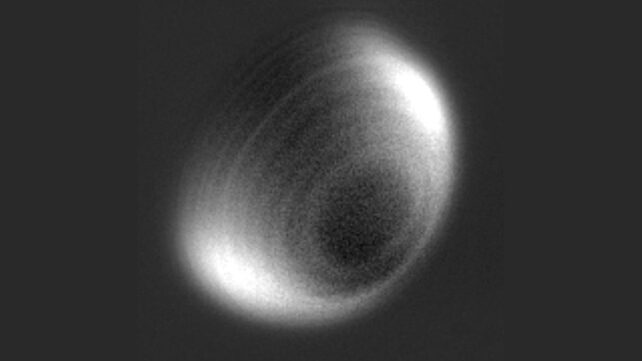
Whatever astronomers glimpsed during a brief observation of Venus in 2010 was not supposed to be there.
During a chance 36-minute observation on an exceptionally clear evening, an experimental instrument recorded something in the planet's atmosphere that had never been seen before.
Vast, concentric rings were encircling much of the planet's day side, completely invisible except when seen in polarized light – as though Venus was ringing like a bell.
The researchers spent the next several years trying to prove the observation wrong… but the signal persisted through every test performed.
Now, they have published their findings in the hope that other researchers will also search for answers.
"It is quite frustrating to have potentially unique observations that cannot be confirmed," atmospheric physicist Gourav Mahapatra of Delft University in the Netherlands, first author of the paper, told ScienceAlert.
"Eventually we concluded that the right scientific approach was not to wait until we could somehow prove the interpretation from a dataset that cannot be repeated. It was to publish exactly what we had, explain the limitations very clearly, demonstrate that the atmospheric interpretation is physically plausible, and allow the wider community to test it."
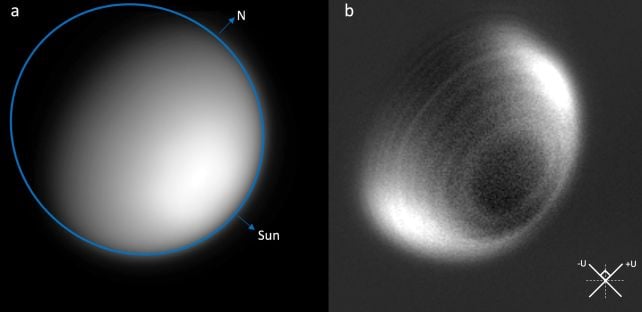
The strange observations were made using an experimental instrument called the Extreme Polarimeter (ExPo), designed by experimental astrophysicist Michiel Rodenhuis during his PhD at the Utrecht Astronomical Institute and installed on the William Herschel Telescope in the Canary Islands.
Unlike an ordinary camera, ExPo recorded linearly polarized light while suppressing ordinary, unpolarized light. Because light becomes linearly polarized when it scatters through gas and dust, the instrument could reveal subtle atmospheric features that would otherwise remain hidden.
One night in 2010, while waiting for the sky to grow dark enough for his planned observations, Rodenhuis noticed Venus shining brightly in the twilight. After a quick discussion with colleague Daphne Stam of Leiden Observatory, Rodenhuis turned the instrument to the planet and collected 36 precious minutes of observations.
It wasn't until months later – long after the instrument had been dismantled and its components used for other purposes – that researchers spotted something hinky in the Venus data.
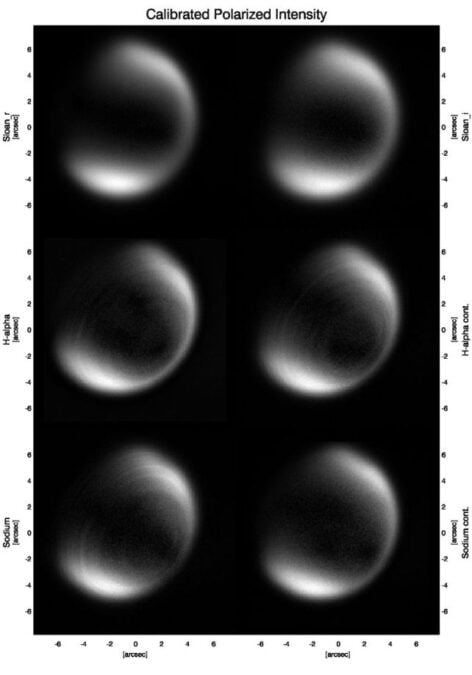
"The first thoughts were that they were due to an instrumental effect, especially because the rings seem to be concentric around the brightest area on the planet: They could be due to a digitization process in the detector or somehow smearing of the signal," Mahapatra explained.
The researchers made an early attempt to make sense of the signal. Although they were unable to explain it away as an instrumental artifact, they still felt the evidence was too limited to support a reliable physical interpretation.
By the time Mahapatra arrived for his own PhD in 2017, two things had changed. Stam had formulated a working hypothesis about what the rings were; and Japanese Venus probe Akatsuki had observed a pole-to-pole wave in the Venusian atmosphere, showing that the planet was capable of planetary-scale atmospheric waves.
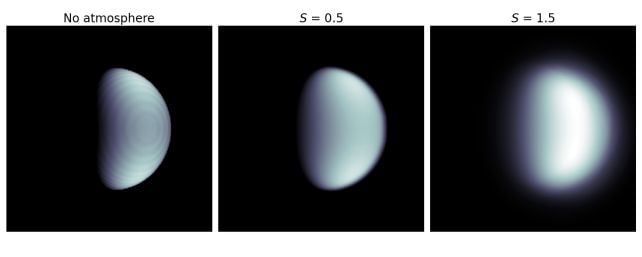
Mahapatra set out to test the idea using computer simulations, asking whether subtle variations in the density of Venus's upper atmosphere caused by atmospheric gravity waves could produce the mysterious signal.
And he got a hit.
Realistic density variations of 5 to 10 percent, the team found, could indeed produce polarization rings similar to those seen in the 2010 observations.
Because the result is based purely on an observation that has not yet been replicated, it's far too early to assert that the rings truly exist – but, if they do, they open a new window into Venus.
"If they are confirmed, I think the most important result would be evidence that large-scale wave activity can produce coherent density structures across enormous regions of Venus's upper atmosphere," Mahapatra said.
"That is exciting because these waves transport energy across the planet. Such processes may ultimately be important for understanding one of the long-standing mysteries of Venus: atmospheric superrotation, where the clouds circulate around the planet much faster than the solid planet rotates!"
Atmospheric waves are nothing unusual. Much like ripples spreading across a pond, disturbances can travel through a planet's atmosphere, compressing and expanding the gas as they go.
On Earth, you can sometimes see the effect of gravity waves in the clouds.
On Venus, they can stretch for thousands of kilometers, carrying energy and momentum between different layers of the atmosphere.
Scientists suspect they play an important role in maintaining the planet's bizarre superrotation, in which hurricane-force winds whip around the entire planet in just four Earth days even though Venus itself takes 243 Earth days to complete a single rotation.
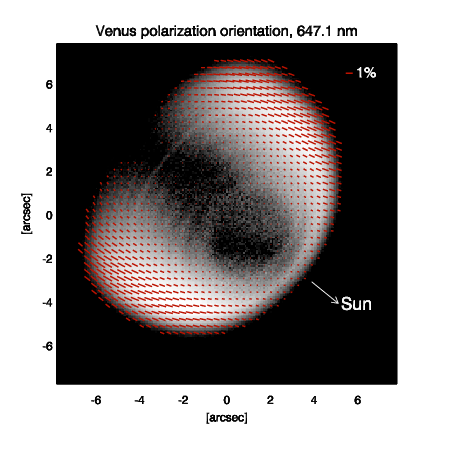
The rings described by Mahapatra and his colleagues are not the waves themselves, but the polarization signature left behind by small changes in the density as the waves ripple through Venus's thick atmosphere.
"We regard our observations not as evidence for a completely unknown kind of atmospheric physics, but potentially as a new way of observing atmospheric dynamics that we already have tantalizing evidence for from spacecraft measurements," Mahapatra said.
"Indeed, while Venus has a very different atmosphere than the Earth – much thicker, hotter, with a different composition and sulfuric acid clouds – a better understanding of Venus also helps to better understand the Earth, because the underlying physical processes are the same.
"Venus helps to test and improve our fundamental knowledge about atmospheres, including the Earth's."

Exactly what triggers the waves remains uncertain. Based on the team's modeling, they appear to emerge sometime after local noon, suggesting they may be linked to the way Venus's atmosphere responds to solar heating as energy is carried through its dense cloud layers.
That, however, may need to be the work of future analysis. For now, the focus remains on figuring out whether the signal was real.
Related: Venus May Be More Earth‑Like Than We Thought – And It's Still Moving
ExPo may be long gone, but it showed that such an observation is possible with current technology. The next step is simply to point a new generation of polarimeters at Venus.
"With a telescope on Earth, these rings can in principle be observed: since 2010, new polarimeters have been deployed on telescopes, also instruments that we might not know about because they are experimental, like ExPo was," Mahapatra said.
"We hope our paper inspires others to observe Venus and to search for and to capture these rings in new observations!"
The research can be read in The Planetary Science Journal.
This article was fact-checked and edited by Clare Watson. While we pride ourselves on our process, we are only human. If you spot a mistake, please let us know.