
While we may not realize it, there are many chemical biomarkers swimming around in our bodies predicting the story of how our health is going to progress in the future.
These biomarkers are particularly useful for researchers and doctors. If someone's risk for a particular condition can be spotted in advance – before the typical symptoms show up – then steps can be put in place to manage, study or treat that condition, or even prevent it from developing in the first place.
In a comprehensive new study, an international team of researchers has just identified a new early biomarker that, when measured in middle age, appears to predict dementia risk in older years.
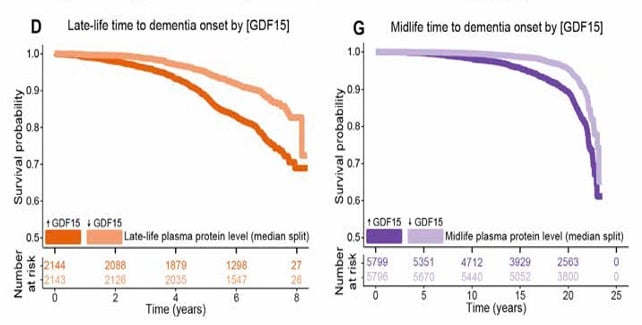
It's a protein called GDF15, found in blood plasma, and data from six large cohort studies showed that people with higher levels of GDF15 in their blood, when aged 55 or younger, were more likely to develop dementia in the decades ahead.
What's more, the researchers think they know why.
"Our results suggest plasma GDF15 may function as an early risk factor for dementia risk by modulating metabolic pathways and the neuroimmune axis," write the researchers in their published paper.
This finding hasn't come out of nowhere. Higher levels of GDF15 in the blood have previously been associated with dementia later in life.
What's new here is that this association also applies below the age of 55.
There were several stages to the study. First, data from six independent cohort studies were collated, covering tens of thousands of people in total. These studies were conducted in the US, the UK, Iceland and Japan.
As well as having blood sample readings for these individuals, the researchers also had access to their health records for follow-up periods of between 15 to 25 years. This revealed an association between higher GDF15 levels and dementia risk.
The relationship was particularly strong for vascular dementia, which is caused by disruptions to the brain's blood supply. The researchers tentatively put this down to GDF15's role in inflammation.

Next, the researchers applied a technique called Mendelian Randomization (MR), where genetic patterns are used as proxies for something else – in this case, elevated levels of GDF15 in the blood.
By combining genetic datasets running to hundreds of thousands of people, the team found that people with genetic variants linked to higher GDF15 were also at a higher risk of dementia.
It's evidence that this biomarker is not just an early sign of the disease, but possibly a driver of dementia, as these genes are independent of lifestyle, environment, and disease.
The researchers weren't finished there either. In smaller datasets, they looked at brain scans and samples of cerebrospinal fluid (CSF), which supports the brain and central nervous system.

There were associations here too: More GDF15 in the blood was linked to more GDF15 in the CSF, and to shrinkage in the brain – though not to the toxic amyloid beta protein clumps associated with Alzheimer's disease.
"We observed a strong correlation between plasma and CSF GDF15 levels, which is consistent with the possibility that circulating GDF15 crosses into the central nervous system," write the researchers.
Finally, tests on immune cells in the lab found evidence of GDF15 interfering with normal biological pathways for immune responses and energy management, possible clues as to why GDF15 could be driving dementia in certain cases.
GDF15 is an important protein for all kinds of cellular processes within the body, but one of its main jobs is keeping the immune system safely in check. Studies have shown that it can suppress cancer spread, for example.
Much more work needs to be done to know for sure, but the researchers suggest that GDF15 might actually go too far in quietening down the immune system when it comes to dementia, leaving the brain vulnerable.
Related: A Single Lifestyle Change Could Lower Your Risk of Dementia by 16%
Further down the line, we may be able to use GDF15 both to spot increased dementia risk early, and to better understand how it develops.
"These findings support circulating GDF15's role as an early biomarker – particularly for vascular dementia and neuroinflammation – and identify the mechanisms by which it may drive dementia risk," write the researchers.
The research has been published in Science Advances.