To help cure Alzheimer's disease and other types of dementia, we need to understand the mechanisms through which it damages the brain – including how the toxic build-up of proteins inside neurons eventually causes their death.
There are multiple ways that cells can die – including a self-destructive mechanism known as apoptosis, that the body uses to clear out waste – but none of them fully account for what's seen in neurodegenerative diseases.
In a new study, reported in Nature Communications and led by a team from King's College London, researchers have documented the role of a potentially crucial contributor, called karyoptosis, which is when the nucleus of a cell degenerates.
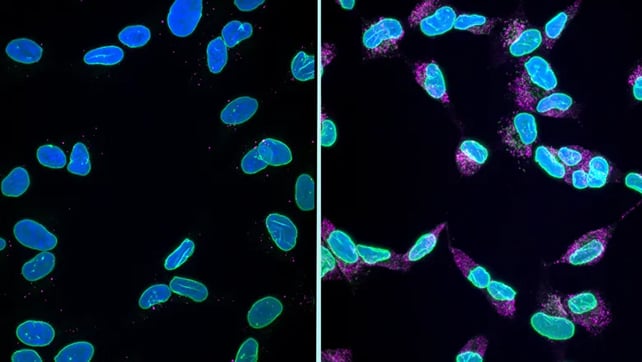
Building on previous research, the team found that karyoptosis happens when harmful waste substances build up faster than cells can clear them out. What's more, they identified key components of the process that could be targeted by treatments.
"The death and loss of cells in the brain drives many symptoms experienced by people living with dementia," says neuroscientist Rebecca Casterton from King's College London.
"Our study uncovers a new series of chemical events which can coordinate cell death in brain cells.
"We have started to lay out the road map of how karyoptosis works, and I'm excited to see future breakthroughs this may drive in the dementia research community and beyond."
Through a lab analysis of brain cells from humans and rats, the researchers found that blocking the trash removal processes inside the neurons – to trigger protein build-up – causes a specific chemical chain reaction to occur.
An enzyme called p38 MAP kinase marks the structural support protein LaminB1 for destruction, which has a devastating impact on cortical neurons: The nucleus disintegrates and collapses, and ejects its own inner material.
This is karyoptosis at the most fundamental level. Significantly, subsequent cell experiments showed that when p38 MAPK was blocked, though nothing changed in terms of toxic protein build-up, the nucleus disintegration and cell destruction were significantly delayed.
"By specifically targeting the interaction between p38 MAP kinase and LaminB1 we may slow down the process of cell death, buying time for more pinpointed therapies against specific neurodegenerative diseases," says functional genomicist Manolis Fanto from King's College London.

Also significant: when the researchers analyzed 3,000 brain cells from 28 patients who had died with either frontotemporal dementia (FTD) or Alzheimer's disease, they found that 35 percent of cells from the frontal cortex brain region showed signs of karyoptosis – compared to just 15 percent in healthy age-matched controls.
"Thus, karyoptosis could account for a substantial proportion of neuronal degeneration, and ultimately cell death, in the forms of dementia assessed here," write the researchers in their published paper.
"Our study uncovers a new series of chemical events which can coordinate cell death in brain cells." – neuroscientist Rebecca Casterton
One of the important next steps is to run experiments targeting the enzyme and protein combination identified here as being at the heart of karyoptosis. That should tell scientists more about the viability of possible treatments.
Dementia comes in a variety of different forms, influenced by a variety of processes and risk factors. Part of what makes understanding and treating the condition is its complexity.
However, even if karyoptosis only accounts for some cell deaths in some cell dementia cases, it seems to be a major culprit connecting dementia with neuron decay – and postponing or preventing that decay would make a huge difference.
Related: Estrogen Loss in The Brain May Help Explain Women's Alzheimer's Risk
"For decades, we've known that toxic proteins build up in Alzheimer's disease and frontotemporal dementia, but exactly how they lead to the loss of brain cells has remained unclear," says Sara Rodrigues, senior research manager at Alzheimer's Research UK, which supported the study.
"The identification of karyoptosis is a crucial step towards finding targets for treatments that could stop or slow cell loss. It could help widen the window for therapies that tackle the underlying causes of disease, bringing us closer to a cure for dementia."
The research has been published in Nature Communications.
This article was fact-checked by Carly Cassella and edited by Peter Dockrill. While we pride ourselves on our process, we are only human. If you spot a mistake, please let us know.