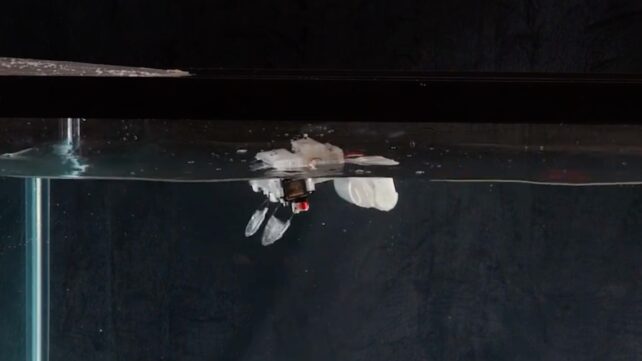
Robot designers often look to the movements of animals for ideas. This machine moves in a way that resembles a frog.
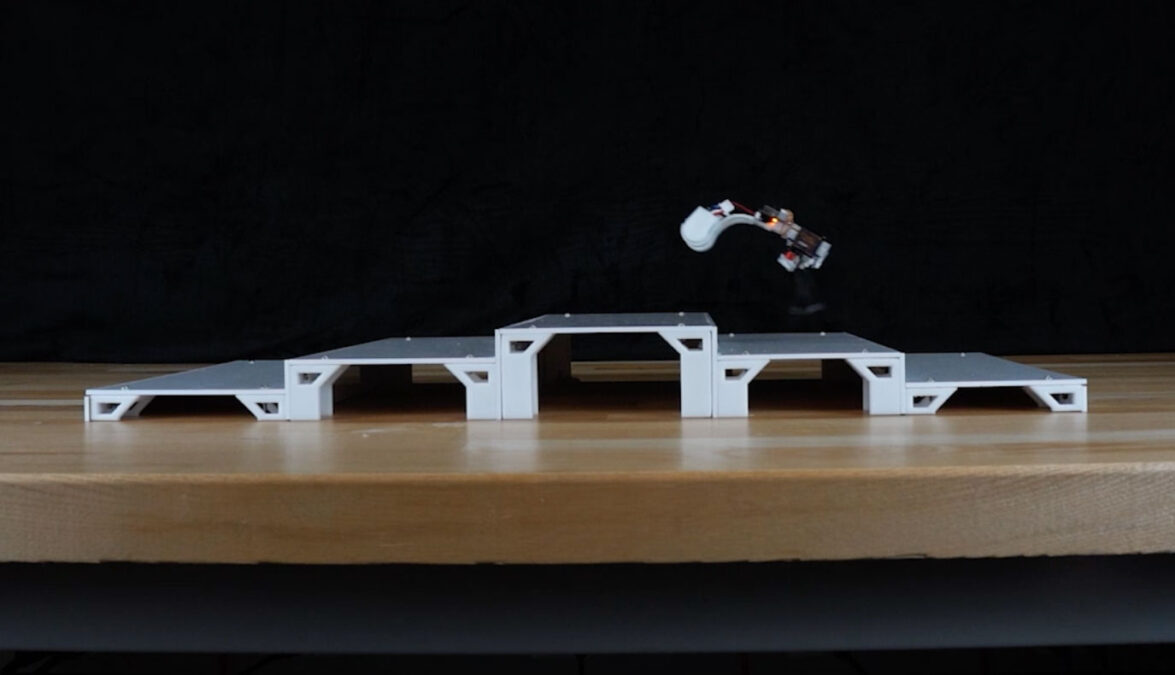
On land, it uses two flexible rear limbs to hop across grass, sand, and small steps. Attach paddles to those same limbs, and it can enter the water and swim.
Researchers at the University of Michigan and the University of California, Los Angeles, developed the palm-sized robot to investigate how flexible structures can give small machines powerful movements without large motors.
They found a way to control when elastic limbs store and suddenly release energy, transforming the steady motion of small motors into an explosive hop.
"Typically, with conventional motors, we get motion relatively steadily, like a wheel turning at the same speed," UCLA mechanical and aerospace engineer M. Khalid Jawed told ScienceAlert.
"But there are cases when a robot needs a sudden burst of power, for example, to hop over an obstacle or get across muddy terrain."
The research began with a simple question: What happens when the ends of a bent, flexible rod are twisted?
Sometimes the rod gradually changes shape. Under other conditions, it stores energy before suddenly snapping into a different form.
The challenge was predicting when that abrupt transition would occur.
The team combined mathematical models, computer simulations, and robotic experiments to map the conditions that produce gradual bending or sudden snapping. They then designed helical elastic limbs capable of reliably storing energy and releasing it in brief, powerful bursts.
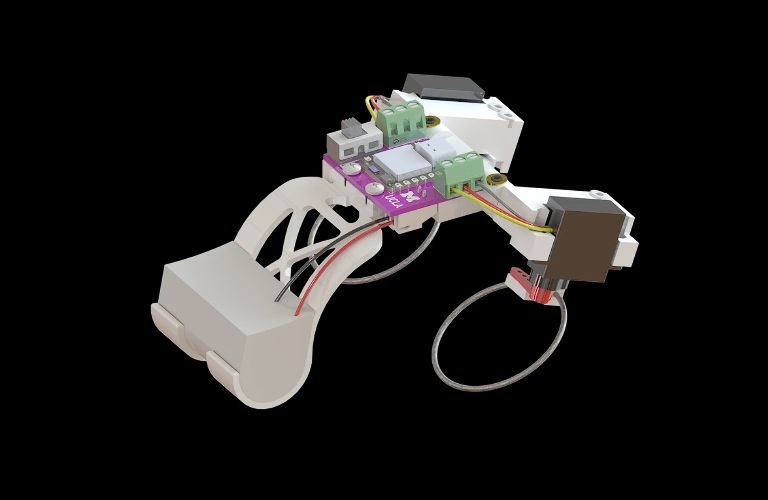
Small motors rotate the ends of two bent rods on the robot. As each rod is slowly bent and twisted, it accumulates elastic energy. Once it reaches a critical point, it snaps into another shape and strikes the ground, launching the robot forward. The motor then reverses to reset the limb for the next hop.
"So a small motor can produce a much more powerful burst of motion than it could generate directly," Jawed said.
"During the snap, we can get a lot more mechanical power than the motor itself is supplying at that instant."
The untethered prototype carries its own battery and control electronics and has a measured mass of 98.2 grams.
In experiments, it sustained hopping across wood, cloth, acrylic, leather, grass, and sand, reaching a top speed of 3.21 body lengths per second.
The researchers also built a nearly identical rigid-legged robot. Using the same core components and tests isolated the contribution of the elastic limbs.
The flexible-legged robot averaged 2.46 body lengths per second, compared with 0.79 for the rigid version. The difference was especially striking on soft cloth and grass, where the rigid-legged robot almost stalled.
The robot could also turn rapidly, perform repeated backflips, and hop up and down small stairs. Under remote control, it followed a path across outdoor sand scattered with small rocks. Onboard light sensors also allowed it to steer toward a light source in a simple autonomous demonstration.
Then came its most eye-catching transformation.
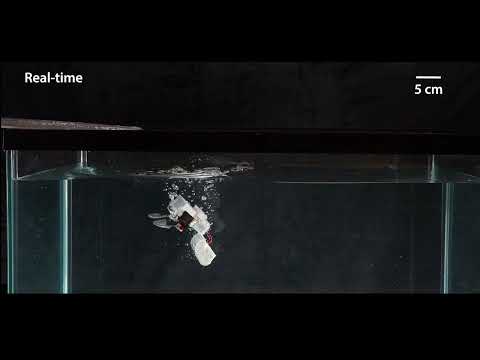
The researchers waterproofed the platform and attached paddles to its looped limbs. The robot hopped into the water and swam at about half a body length per second. It was also tested in an outdoor pool with underwater obstacles and wind, according to Jawed.
However, the swimming system was not specifically optimized.
Jawed stressed that the machine remains a research prototype. Its output comes in bursts rather than varying continuously, and each elastic limb must reset after snapping. The snap and reset must also be timed with the robot's movement and its interaction with the surrounding environment.
The approach could eventually provide bursts of power when a robot needs to clear an obstacle or cross muddy ground.
"Generally speaking, we can use this mechanism for the robot to perform high-power maneuvers without requiring a large motor," Jawed said.
That principle may become particularly useful as robots shrink. Tiny machines have little room for heavy motors and complex transmissions, yet still need enough power to overcome obstacles or escape soft terrain.
Because snapping is governed by the structure's shape rather than simply its size, the researchers think the design rules may work at different scales, potentially including robots only a few millimeters wide.
The prototype is not yet an all-terrain amphibious explorer. Its burst-like movement, reset cycle, timing requirements, and unoptimized swimming all leave room for development.
Even so, it demonstrates a compelling design idea: instead of demanding every powerful movement directly from a motor, engineers can make the robot's structure store energy and release it at precisely the right moment.
For a machine small enough to disappear in tall grass, that well-timed snap could mean the difference between getting stuck and hopping away.
It could even turn a hop into a swim.
The study was published in Science Advances.
This article was fact-checked by Peter Dockrill and edited by Peter Dockrill. While we pride ourselves on our process, we are only human. If you spot a mistake, please let us know.