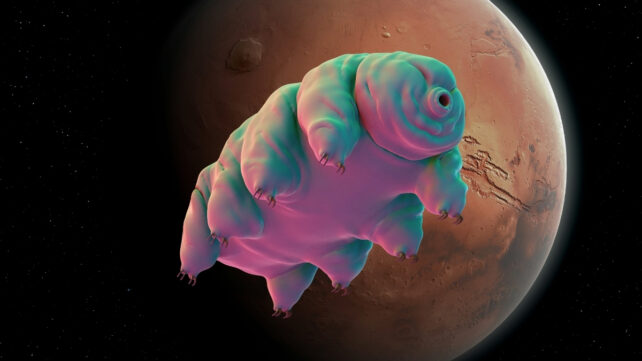
Tardigrades are renowned for their exceptional survival skills, but one environment has been found to test them to the limit.
Exposed to a mix of minerals designed to replicate dirt found on Mars, two different species of tardigrades struggled to survive, declining rapidly in numbers in just a few days.
However, once the simulated Mars dirt had been rinsed with water, the microscopic animals fared much better – an encouraging discovery for future farming efforts on the red planet.
"When considering sending people to non-Earth environments, we need to understand two things: how the environment will impact the people and how the people will impact the environment," says microbiologist Corien Bakermans of Pennsylvania State University.
"With this research, we're looking at a potential resource for being able to grow plants as part of establishing a healthy community – but we're also looking at whether there are any inherent damaging conditions in the regolith that could help protect against contamination from Earth, which is a goal of planetary protection."
While previous experiments have identified at least some plants that can grow in simulated Mars dirt – or regolith – there's still a lot we don't know about how many of Earth's organisms might respond to it.
Here on our home planet, tardigrades are everywhere. These microscopic eight-legged animals bustle about in a wide range of conditions around the globe. They play important roles in their ecosystems, both predator and prey.
If we ever try to build functioning soil ecosystems on Mars, organisms like tardigrades could help regulate microbial communities.
They're also a good model organism for studying animal development and survival under extreme conditions. Tardigrades are among the hardiest critters on the planet thanks to a survival toolkit that includes a protein that protects their DNA, a dehydrated 'tun' state they can enter when external conditions become untenable, and highly effective damage repair.

With crewed missions to Mars just over the space-exploration horizon (hopefully), Bakermans and her colleagues turned to tardigrades as a way to assess the habitability of Mars regolith and maybe find ways to improve it.
"We know a lot about bacteria and fungi in simulated regolith, but very little about how they impact animals – even microscopic animals, like tardigrades," Bakermans says. "We investigated the specific, isolated impact of the regolith on tardigrades."
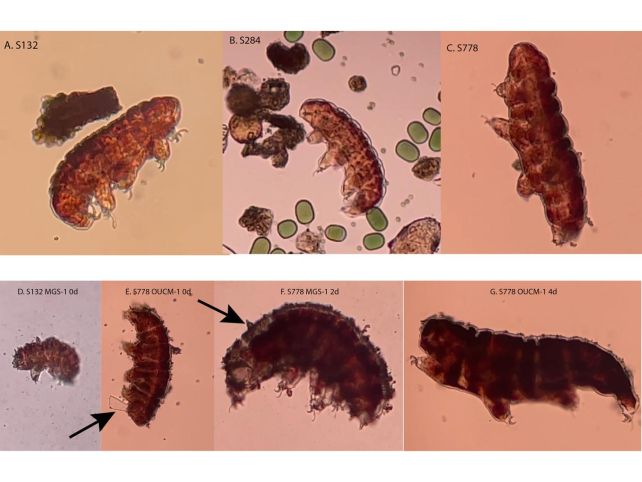
Their experiments focused on two species of tardigrade: Ramazzottius cf. varieornatus, a hardy land-dwelling species, and Hypsibius exemplaris, which lives in freshwater.
Groups of each species were placed in two different Mars regolith simulants, called MGS-1 and OUCM-1, and observed for several days. Groups of each species were also placed in normal Earth beach sand to serve as a comparison control.
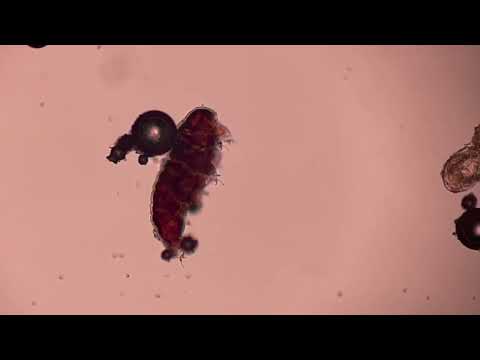
In both simulants, the number of living, active tardigrades dropped sharply after four days. MGS-1 was particularly inhospitable – all of the Hypsibius tardigrades were dead within two days. Ramazzottius did somewhat better, but their numbers still declined.
OUCM-1 was better, but still not great. Most of the populations declined sharply, with just one Ramazzottius group showing only minimal impact. Meanwhile, tardigrades in the sand chugged along, healthy and active.
Theorizing that there was something in the MGS-1 sand that could be washed away, the researchers gave the simulant a rinse and tried again.
This is where the experiment got interesting. The tardigrades placed in the washed simulant survived longer with activity levels similar to those seen in the Earth control.
Related: Scientists Fired Tardigrades Out of a Gun to See if They Can Survive Space Impacts
"It seems that there's something very damaging in MGS-1 that can dissolve in water – maybe salts or some other compound," Bakermans says.
"That was unexpected, but it's good in a sense, because it means that the regolith's defense mechanism could stop contaminants. At the same time, it can be washed to help support plant growth or prevent damage to humans who come in contact with it."
There's more work to be done, of course. Whatever it is in MGS-1 that is so damaging to tardigrades remains to be isolated. The researchers ruled out possibilities such as pH and salinity, but toxic chemicals, reactive minerals, or superfine particles that impede tardigrade movements could still be factors.
The researchers also did not examine other properties of the Martian environment, such as radiation, atmospheric pressure, or temperature. Still, every tiny step of knowledge will help climb the mountain of difficulty that is Mars.
"We're beginning to tease apart components of this overall system where any single piece could be a drawback or benefit the larger understanding of planetary protection," Bakermans says.
The research has been published in the International Journal of Astrobiology.