You probably don't think much about the blood running through your veins on a daily basis.
Like the neurons firing in your brain, or the constant in-and-out of your breath, it's just always there in the background – an inconspicuous feature of your body helping to keep you alive.
To some scientists, however, that red fluid pulsing through every extremity with each beat of your heart, transporting the oxygen your cells so desperately need, represents a fascinating mystery.
Nearly every animal on this magnificent planet has blood… but where the heck did it come from?
Now, in an ambitious effort, an international team led by Kyoto University in Japan has traced the evolutionary history of blood cells back 700 million years – and discovered that they weren't created from scratch after the rise of multicellular life.
Instead, blood appears to have been cobbled together from recycled and upgraded genetic machinery inherited from single-celled ancestors that lived hundreds of millions of years before animals first emerged.
"I feel deeply moved by these findings, which represent the culmination of our work and illustrate that the differentiation pathways of vertebrate blood cells reflect the 700-million-year evolutionary history of these cells," says immunologist Hiroshi Kawamoto of Kyoto University, who led the study.
Compared to some aspects of evolutionary history, tracing the path of blood is breathtakingly difficult. Bones, scales, feathers, and shells fossilize. Cells usually do not.
So, understanding where they come from requires an indirect approach.
The basic unit from which the researchers compiled their evolutionary history is the transcriptome – basically, a snapshot of gene expression that shows which genes are active and which are not in any given cell.
They collected transcriptome data for a wide range of species, including humans, mice, zebrafish, sea squirts (tunicates), sea urchins, flies, worms, sponges, and some unicellular organisms.
Then the researchers looked for shared patterns, reasoning that if two very distant cell types use deeply similar regulatory machinery, they may descend from the same ancestral cell program.

Although it's possible that two organisms can evolve similar traits independently, that becomes far less likely the deeper, more widespread, and complex those similarities are.
The results of this analysis revealed that the first blood cells were likely very unlike the sophisticated, streamlined oxygen couriers hard at work in your body today.
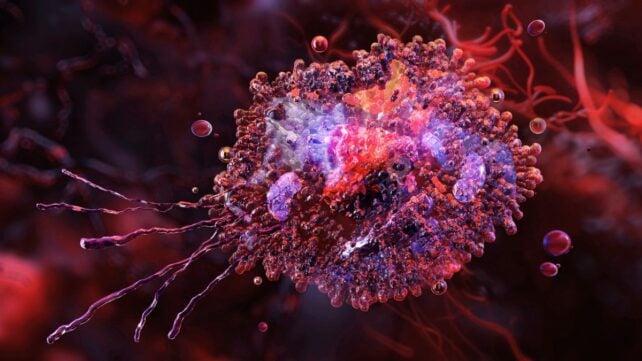
Instead, they would have been scrappy, amoeba-like things similar to macrophages, the large white blood cells that make up the tank squad of your immune system – mobile scavengers capable of engulfing and digesting interloping microbes.
But they didn't appear out of nowhere, either.
When the researchers compared the genetic activity of blood cells to that of the modern single-celled organisms closely related to animals in their study, they found some striking similarities.
Some of the unicellular organisms had genetic programs that were very close to those of macrophages, including phagocytosis – the process of engulfing and consuming particles.
To interrogate that connection further, the researchers turned to a gene they repeatedly found in both animal blood cells and unicellular organisms: Fos.
The gene helps regulate how cells grow and change, and its repeated appearance across such distant organisms made it a prime suspect.
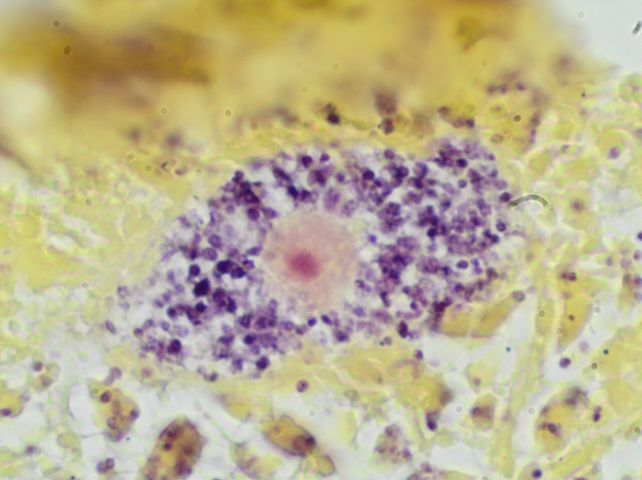
They chose one unicellular organism, and turned Fos expression all the way up – and observed that, instead of clustering together as the organism usually does, the cells remained in an isolated, amoeba-like state.
The results imply that the genetic machinery for macrophage-like behavior first emerged in single-celled organisms hundreds of millions of years before animals and unicellular eukaryotes diverged from a common ancestor.
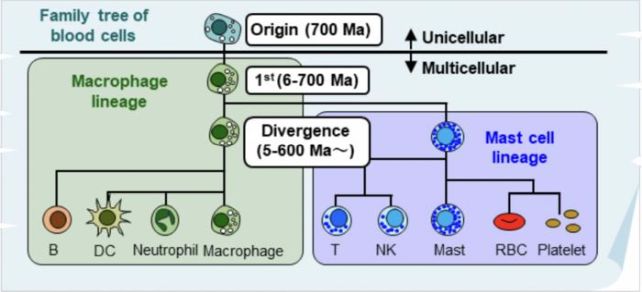
From here, the researchers think blood cells split into two major evolutionary branches.

From the macrophage-like ancestral blood cells, a second major lineage eventually split off: the ancestors of mast cells, the immune cells that act as the alarm against intruders.
Related: Scientists Identified a New Blood Group After a 50-Year Mystery
These mast cells later gave rise to T cells, red blood cells, and platelets, while macrophages went on to produce the B cells that make antibodies.
These findings, the researchers say, could help unravel the evolution of diseases such as cancer – but they also demonstrate a deep-time heritage from our earliest, humblest beginnings.
"When I let it sink in that this legacy from so long ago is circulating within my body as blood cells, I feel closer to our distant ancestors," says immunologist and first author Yosuke Nagahata of the Institute of Evolutionary Biology in Spain.
The findings have been published in the Proceedings of the National Academy of Sciences.