The cosmos wavers between predictable stability and wild chaos, which troubles our sense-seeking brains.
In our local Solar abode, the stability of the planets "is the question around which celestial mechanics was built".
Presumably even before such words existed, as our ancient relatives wondered about the twinkling fires in the night sky.
Millennia later, the supposedly apple-pelted Isaac Newton suspected that the architecture of our outer planets might unravel.
But the modern math of Uranus suggests that they could remain stable for a quintillion years – over 70 million times the current age of the Universe.
Even considering the evolution of the Sun and alien stars shooting in from space, the outer planets could remain undisturbed for 100 billion years.
Or so it was believed, based on assumptions that our dying Sun, six-ish billion years hence, would shed about half of its mass as it slowly devolves into a white dwarf.
Yet the outer Solar System's doomsday may be much, much closer at hand, a new study suggests, because the Sun isn't going out calmly, but kicking and screaming.
Well, perhaps not so much screaming, but literally kicking.
As published in The Astrophysical Journal Letters, theoretical astrophysicists Konstantin Batygin and Jim Fuller of Caltech, and Fred Adams of the University of Michigan, have found evidence that the Sun's mass loss will not be smooth but turbulent and random, ejected in thousands of individual "kicks".
"The surprise is what happens when smoothness gives way to granularity: break the mass loss into discrete ejection events and the picture changes wholesale," Batygin told ScienceAlert.
"The demise of the Solar System was hiding inside one of celestial mechanics' most reassuring results."
Each ejection will push our dying Sun into a slightly different position, changing its gravitational influence on every planet.
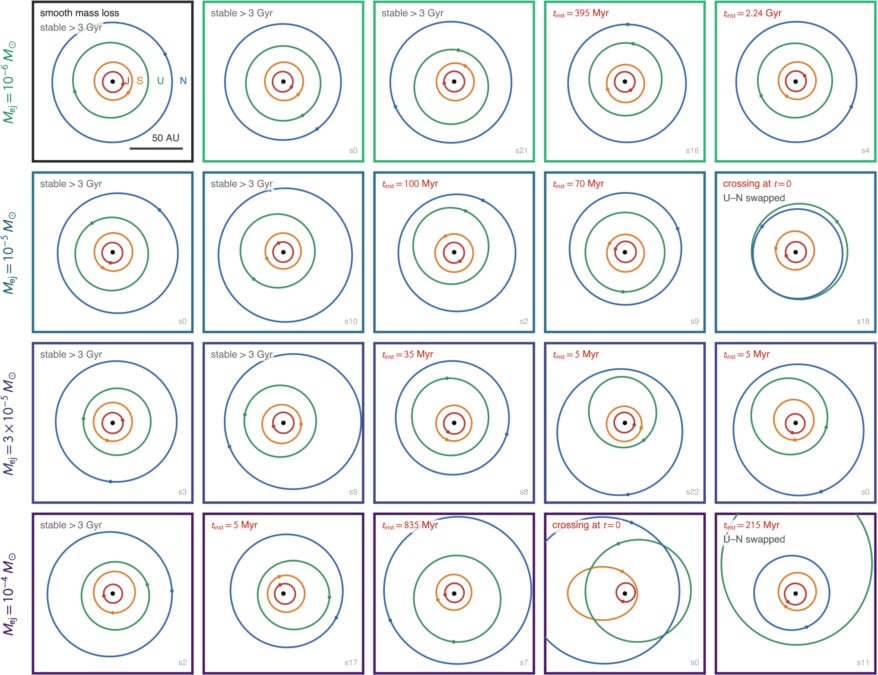
If such bursts were symmetrically ejected, their gravitational influence might average out. But their randomness can lead to tiny changes that add up to huge shake-ups in our far-out Solar family.
The researchers found evidence of such kicks in data from the European Space Agency's recently retired Gaia orbital observatory, which observed wide stellar binary systems that included white dwarfs.
They then simulated several levels of mass loss kicks from our future Sun.
The researchers decided that each Sun-killing-kick may blast one ten-thousandth of its mass, or about 33 Earths, out into space.
This occurs higgledy-piggledy across 4,600 ejection events, each changing the Sun's speed by about seven meters (23 feet) per second – like an astronaut sneezing, or otherwise expelling bodily air, and being propelled in the opposite direction.
Of the almost 700 simulations, the primary focus is on 48 that included the most realistic mass loss ejected during the Sun's dying stages.
In nearly 80 percent of these (37 out of 48) scenarios, the outer planets start crossing each other's orbits unexpectedly early, long before the Sun has even finished losing its outer layers.
In the earliest of such scenarios, the outer planets are already intermingling in their orbits when the Sun has only lost about 10 percent of its mass.
By the time our Sun has actually morphed into a white dwarf, the outer Solar System ends up in dismal disarray in 40 percent of the projections.
For example, Uranus and Neptune may swap positions, and even dive within Jupiter's orbit, creating planetary chaos comparable to a cosmic combination of duck, duck, goose and a demolition derby.
We may also lose our prized jewel.
Poor Saturn may be ejected within a few million years, being demoted from our stunning 'king of the rings' to an orphaned rogue planet forced to wander deep space for endless eons, or possibly until it's adopted by another star system.
The planetary prognosis isn't promising.
"We lose them. In nine out of ten of our simulations, at least one giant planet is hurled into interstellar space," Batygin told ScienceAlert.
"This dovetails with microlensing surveys, which suggest there may be as many free-floating planets in the galaxy as there are stars – dying suns are plausibly a major source."
Altogether, in 90 percent of the models, our Solar System self-destructs within three billion years after the Sun becomes a white dwarf. So, less than 10 billion years from now.
This work offers a much grimmer projection than ever before: our Solar System may be disrupted 100 times faster than previously estimated, perhaps even before our Sun is a white dwarf.
"Newton's envisioned instability is real after all," the researchers write in their paper.
"He was mistaken only about the perpetrator."
Instead of being gravitationally destroyed by an alien interloper – an increasing risk as the Sun loses mass and the planets' orbits expand – it will be disrupted internally.
As in classical tragedy, the Solar System may be destroyed by the inextricable conditions of our birth and growth.
Accordingly, who can imagine what will have become of us by the time our home is destroyed? Will our descendants, whatever they may be, watch from distant outposts as our ancestral cosmic birthplace unravels?
Finally, this work also changes our understanding of the Universe, which hosts countless Sun-like stars.
"Ninety-seven percent of stars die this way, and many of the systems out there are more fragile than ours," Batygin said.
"The quiet retirement we imagined for planetary systems is a myth."
The research has been published in The Astrophysical Journal Letters.
This article was fact-checked by Rachel Garner and edited by Peter Dockrill. While we pride ourselves on our process, we are only human. If you spot a mistake, please let us know.