
Plastic pollution is seeping into the Earth, into wildlife, and into our bodies, and a new research review suggests tiny microplastics and nanoplastics could be disrupting some of the brain processes associated with Parkinson's.
While Parkinson's disease is associated with a wide range of risk factors, the rise we're seeing in the number of people being diagnosed – its prevalence has doubled in the last 25 years – could be at least partly down to a rise in pollutants in the environment.
For this recent review, a team from Gannan Medical University and Guangzhou Medical University in China referenced more than 100 previous studies, including animal studies, laboratory experiments, and computational models, to build a compelling case linking plastics to Parkinson's.
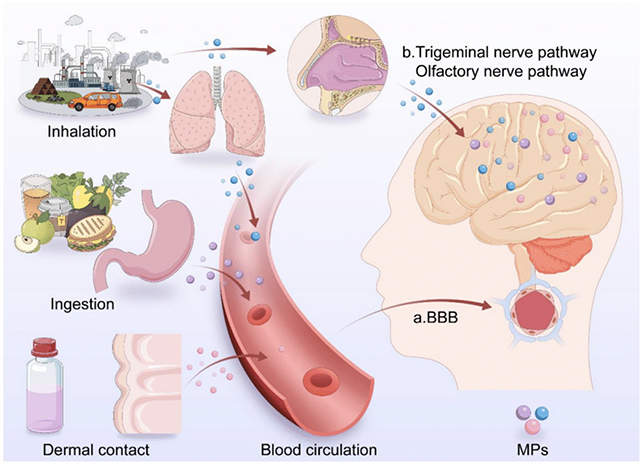
While it's not yet clear that microplastics are directly responsible, the researchers are calling for the association to be investigated further: more data is badly needed on how these ubiquitous particles may accumulate in the body and harm human health.
"With the intensification of global plastic pollution, the potential threats posed by micro- and nanoplastics (MPs/NPs) to human health have become a major concern," write the researchers in their published paper.
"MPs/NPs enter the organism through ingestion, inhalation, and skin contact, subsequently accumulating in multiple organs – particularly the brain."
Microplastics are defined as fragments smaller than 5 millimeters, while nanoplastics are smaller than a micrometer – a thousandth of a millimeter. They enter the environment in numerous ways, including dissentegration of plastic waste and the release of water used to wash synthetic clothing.
Connecting findings from previous studies, the review states we ingest plastics through our food and drink, breathe them in through the air, and even absorb them through our skin.

From there, microscopic plastic fragments make their way into our brain by crossing the blood-brain barrier or entering the nerve cells lining of our nasal cavity.
To speculate on what the plastic might do when it's in the brain, the researchers point to studies showing microplastics and nanoplastics encouraging the formation of toxic alpha-synuclein protein clumps typical of brains with Parkinson's.
The review presents evidence that plastic fragments may drive neuroinflammation, disrupt communications between the brain and the gut, and carry damaging metals into the brain – a process known as ferroptosis.
All of these types of damage have been connected to Parkinson's disease in the past.
The chain of emerging evidence that starts with tiny plastics and ends with brain damage associated with Parkinson's is intriguing, but the authors say that current research on the topic is "significantly limited" and that the chronic effects of human exposure and toxicity "remain incompletely characterized." It's worth emphasizing that most of the scientific work reviewed here is based on animal testing or experiments on cells in the lab.
"MPs/NPs, as pervasive environmental contaminants, infiltrate humans through multiple exposure routes, traverse biological barriers, and accumulate in the central nervous system – constituting a novel environmental hazard for Parkinson's disease pathogenesis," write the researchers.
And it's not just in the brain where microplastics and nanoplastics pose a threat. An increasing amount of research connects the pollutants to problems with fertility, antimicrobial resistance, cardiovascular issues, and more. Recently, scientists have argued that contamination and false positives are too common in this field of research.
The researchers behind this new study want to see more done to reduce plastic pollution, improve waste management, and find biodegradable alternatives to the plastics that have made their way into so many aspects of our lives.
Related: A Signal of Parkinson's May Be Hiding in Your Hair, Study Finds
That will have to change in the future if we're going to fully understand what the threats from microplastics and nanoplastics actually are in terms of neurodegenerative diseases. As the global population gets older, the burden of diseases such as Parkinson's is likely to continue to grow.
"Future research must systematically compare how MPs/NPs properties – including size, shape, surface charge, polymer type, and degradation state – influence Parkinson's disease-related pathways," write the researchers.
The research has been published in npj Parkinson's Disease.