
It's not clear exactly how dementia gets started or might be stopped, but we do know that there are many different risk factors for the condition, ranging from hearing impairments to breathing polluted air.
While some risk factors like genetics can't be changed, and others, such as air pollution, reflect systemic, societal problems, a number of dementia risk factors fall within the realm of modifiable lifestyle factors – things we can potentially do something about.
A new study from researchers in the US and China, published in Neurology Open Access, has identified three middle-age risk factors that are associated with a later dementia onset. In other words, more dementia-free years.
Analyzing the health records of 12,409 participants spanning a median of 26 years, the team found that having normal blood pressure, not having diabetes, and not smoking were linked to almost 13 additional years without dementia, on average.
The crucial years for these risk factors were from 45 to 65, emphasizing the importance of good health in middle age – and in particular vascular health, the condition of your blood vessels, which blood pressure, diabetes, and smoking can all affect.
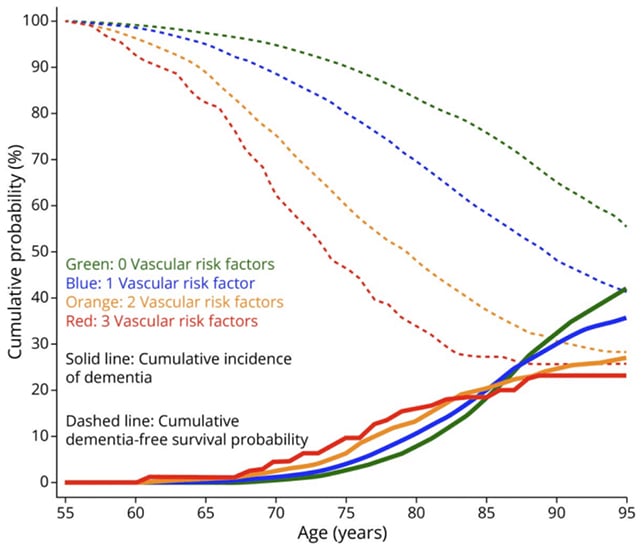
"Maintaining optimal midlife vascular health was associated with up to 12.6 additional dementia-free survival years, reflecting both higher dementia hazard and markedly higher competing mortality," write the researchers in their published paper.
"Expressing vascular risk in time-based terms offers a clear, patient-centered framework to motivate prevention strategies that preserve both cardiovascular and cognitive health."
Several other factors were accounted for in the analysis, including sex, race, age, physical activity levels, and the presence of the APOE4 gene that significantly increases the risk of Alzheimer's disease.
As well as developing dementia earlier, those with all three identified risk factors were more likely to die at an earlier age.

However, the study isn't enough to prove direct cause and effect between these risk factors and developing (or not developing) dementia over time. What it does is provide strong evidence that these factors matter.
"Our findings argue that people need to actively avert these factors in midlife as a strategy for preserving brain health for more than a decade," says epidemiologist Josef Coresh, from New York University (NYU) Langone Health.
"Discovering new ways to delay dementia is crucial with 42 percent of Americans at risk for developing the condition at any time after age 55."
While these three risk factors have been connected to dementia before, it's worth emphasizing that here they were considered together, showing the importance of vascular health as a whole.

There were some other findings from the data worth mentioning. Women with all three risk factors lived an average of 18.1 years without dementia from the start of the study period, compared to 16.6 years for men.
For white participants, it was 19.6 years on average, compared to 16 years for Black participants, highlighting known health disparities.
"These results suggest that vascular risk reduction may benefit all groups, but that certain populations, such as Black adults, may especially benefit from targeted prevention efforts," says Coresh.
"Hopefully, these results will encourage people to stop smoking and watch their vascular health closely from age 45 on."
Future research could look at how changes in these three factors – quitting smoking or reducing blood pressure, for example – may shift the dial in terms of dementia risk.

Every year, another 10 million people across the globe develop dementia, and the number of people living with the disease is expected to rise in the future.
Any insights about how this complex disease starts and affects certain people bring us another step closer to better treatments.
An increasing number of studies, like this one, are now looking at not only whether or not someone gets dementia, but when the dementia starts – which will be increasingly important as the global population gets older.
Related: Women's Dementia Risk May Be Shaped by These Key Factors, Study Finds
"Consistent with these studies, our findings further highlight how the accumulation of vascular risk factors affects dementia-free survival," write the researchers.
"This shift from dementia incidence to dementia-free survival offers a clearer perspective for understanding the impact of vascular health on cognitive aging trajectories."
The research has been published in Neurology Open Access.
This article was fact-checked by Clare Watson and edited by Clare Watson. While we pride ourselves on our process, we are only human. If you spot a mistake, please let us know.